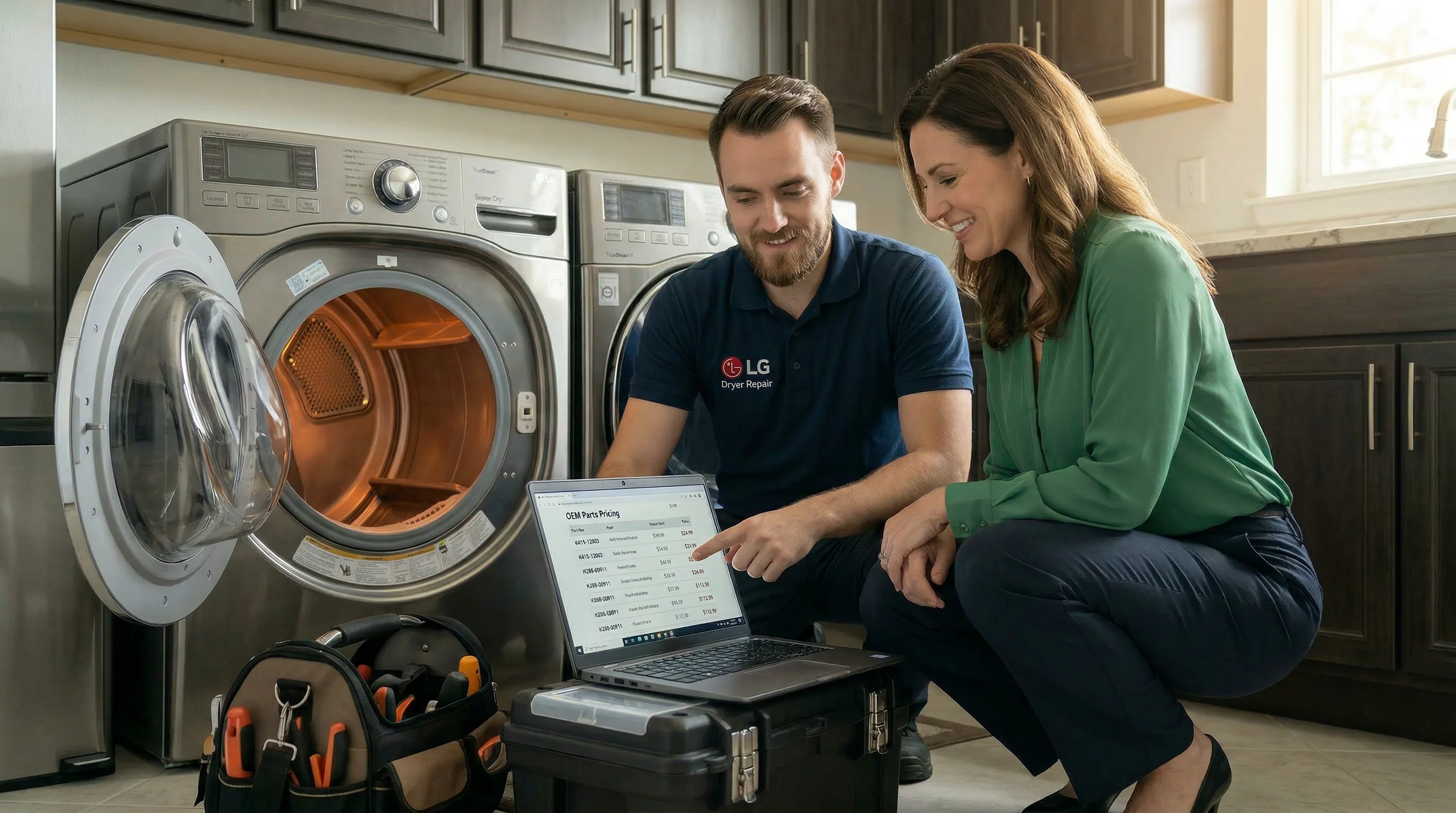
Dryer vent cleaning costs $150–200 total in Los Angeles County, Orange County, and Ventura County — no parts, just labor. That covers clearing the duct from both ends, checking the exterior cap, measuring airflow before and after with an anemometer, and confirming your LG dryer's d80/d90/d95 Flow Sense codes are gone. This is one of the most cost-effective things we do — a $150–200 cleaning prevents $280–350 thermal fuse replacements and keeps properly maintained dryers running 12–15 years instead of 8–10. We do these calls all over LA, Orange County, and Ventura County every day.
Cost breakdown
How Much Does Dryer Vent Cleaning Cost?
$150–200 total for most homes. What pushes toward $200: runs over 20 feet, multiple bends where lint packs in at every turn, or exterior caps clogged solid from years of use. We see the worst of it in Burbank and Glendale where older homes have original ductwork from the 1970s — longer runs, more bends, and some of the thickest lint accumulation we encounter anywhere in our service area.
What keeps it at $150: short straight runs in newer construction, easy exterior cap access, single-family homes in Thousand Oaks and Moorpark with clean installations from the start.
One thing we always check before we start: whether the thermal fuse has already blown from the sustained overheating. If it has, the vent cleaning fixes the cause but the dryer still won't heat — fuse replacement is needed too ($280–350 additional). We test the fuse first so you know exactly what you're looking at before we open anything up. Both jobs done at the same visit — one trip charge, not two.
What's Actually Included — Not Just "Vent Cleaning"
We see a lot of calls where someone had a "vent cleaning" that didn't fix the d80 code. Usually because the job was done incompletely — brush pushed through from one end only, exterior cap never checked, no airflow measurement after. Here's what a proper cleaning includes:
Airflow measurement before we start. We run the dryer and measure actual airflow at the exterior cap. This tells us how restricted the vent is and gives us a before number to compare against.
Clearing from both ends. We disconnect the duct at the dryer and clear from the dryer end with a flexible brush and vacuum. Then we clear from the exterior cap end. Clearing from only one end pushes lint toward the other — you need both for a complete job.
Exterior cap inspection. The cap on the outside of the house gets checked for a stuck damper, bird nest, or solid lint pack inside the housing. On a lot of homes in Pasadena and Glendale we find the cap itself is the blockage — everything behind it is fine.
Transition duct check. We look at the flexible section directly behind the dryer for kinks, crushing, or foil accordion duct that's partially collapsed. A kinked transition duct restricts airflow regardless of how clean the main duct is.
Airflow measurement after. We run the dryer again and confirm flow is adequate at the exterior cap. On LG dryers this means d80/d90/d95 codes are gone and airflow you can feel clearly. We don't call it done until the numbers confirm it.
What We Find on Cleaning Calls — and When We Tell You Something Else Is Needed
About 20% of cleaning calls reveal something that cleaning alone won't fix. We'd rather tell you on-site than have you call back in two weeks wondering why the d90 code came back.
Foil accordion duct that's partially collapsed. The most common find in apartments in Irvine and Burbank. You can brush through it but it still restricts airflow because the material itself is kinked. It needs to be replaced with rigid metal. We carry materials and can often do it same visit.
Thermal fuse already blown. We test it before we start. Vent cleaning fixes the cause, but the dryer still won't heat until the fuse is replaced. We do both same visit.
Run length that exceeds code limits. California allows maximum 35 equivalent feet based on number of bends. If the existing installation exceeds this, cleaning helps but doesn't fully solve the airflow problem. We explain this and quote a rerouting if needed.
Internal lint around the heating element. Lint that bypasses the trap over years of use accumulates inside the dryer cabinet around the heating element housing. Older LG DLE series with years of heavy use in Torrance and Long Beach often have significant internal buildup alongside vent blockage. We note this when we see it and can clean the interior at the same visit — it's not part of standard vent cleaning but it's worth doing when we're already there.
How Often Should You Clean the Dryer Vent?
Every 1–2 years for average use. Every year if you run the dryer daily or have pets — pet hair packs into lint and accumulates in the duct faster than regular lint. Every 6 months if your vent run is over 15 feet or has multiple bends.
Signs you need it now: LG dryer showing d80 or d90 codes, clothes taking noticeably longer to dry than they used to, the exterior vent flap barely moving when the dryer runs, or the dryer shutting off mid-cycle. Any of these means the vent is already partially blocked. Clean it this week, not on the regular schedule.
What regular cleaning prevents: thermal fuse failures ($280–350), heating element stress from sustained overheating ($300–380), and worn drum rollers from the motor working harder against restricted airflow ($280–350). The $150–200 cleaning pays for itself in avoided repairs. Properly maintained dryers in our service area regularly hit 12–15 years — unmaintained ones start having problems at 8–10.
DIY vs Professional — the Honest Version
Hardware store vent cleaning kits run $20–40 and work fine for short straight runs under 10 feet with good access. For most LA, Orange County, and Ventura County homes — longer runs, multiple bends, stucco exteriors — they fall short:
Consumer kits don't measure airflow. You can push a brush through and feel like the job is done when the vent is still 40% restricted. We measure before and after and show you the numbers.
Consumer kits struggle around bends. Most installations have at least two 90-degree turns — kits get stuck or push lint into the bend rather than through it.
Consumer kits don't check the cap, the transition duct, or the thermal fuse — the three things we find most often on problem calls.
If your run is under 10 feet and straight, a DIY kit is reasonable. Anything more complex — and in LA, OC, and Ventura most installations are — professional cleaning at $150–200 is the better call.
Los Angeles County, Orange County, Ventura County — Same Pricing
No surcharges for Orange County or Ventura County. Beverly Hills, Pasadena, Burbank, Glendale, Long Beach, Torrance, Santa Monica, Calabasas, Malibu in LA County. Irvine, Newport Beach, Laguna Beach, Mission Viejo, Yorba Linda, Laguna Niguel in Orange County. Thousand Oaks, Moorpark, Westlake Village, Camarillo, Simi Valley, Newbury Park in Ventura County.
Monday through Saturday 8am–7pm, Sunday 9am–5pm. Same-day service, most areas 2–4 hours from your call.
Related: Dryer Vent Installation Cost · LG Dryer d80/d90/d95 Error · Thermal Fuse Replacement · LG Dryer Not Drying · LG Dryer Overheating
Questions About Dryer Vent Cleaning Cost
How much does dryer vent cleaning cost in Los Angeles?
$150–200 total — no parts, just labor. Includes clearing from both ends, airflow measurement before and after, exterior cap inspection, and d80/d90/d95 confirmation on LG dryers. Same pricing across LA County, Orange County, and Ventura County.
My LG dryer shows d80 or d90 — will vent cleaning fix it?
In most cases yes. d80 and d90 mean 80% and 90% airflow restriction — cleaning removes the blockage and the code goes away. If the thermal fuse already blew from the overheating, the code clears but the dryer still won't heat. We test the fuse before we start so you know what you're dealing with before we open anything.
How often should I clean my dryer vent?
Every 1–2 years for average use. Every year if you run daily or have pets. Every 6 months for long runs with multiple bends. Don't wait for the d80 code — by the time it appears, the vent is already 80% blocked.
How long does dryer vent cleaning take?
45–90 minutes for most homes. Short straight runs take 45 minutes. Long runs with multiple bends through walls and ceilings take closer to 90. We measure airflow after and don't leave until the numbers confirm the vent is actually clear.
The vent was just cleaned but d80 came back. Why?
Two most common reasons: the previous cleaning was done from one end only and didn't fully clear the blockage, or the duct has a section of flexible foil accordion material that's partially collapsed — you can brush through it but it still restricts airflow. We assess both scenarios and tell you on-site which it is.
Can you come today?
Yes — call (323) 990-7550. Same-day dryer vent cleaning across Los Angeles County, Orange County, and Ventura County, typically 2–4 hours from your call.