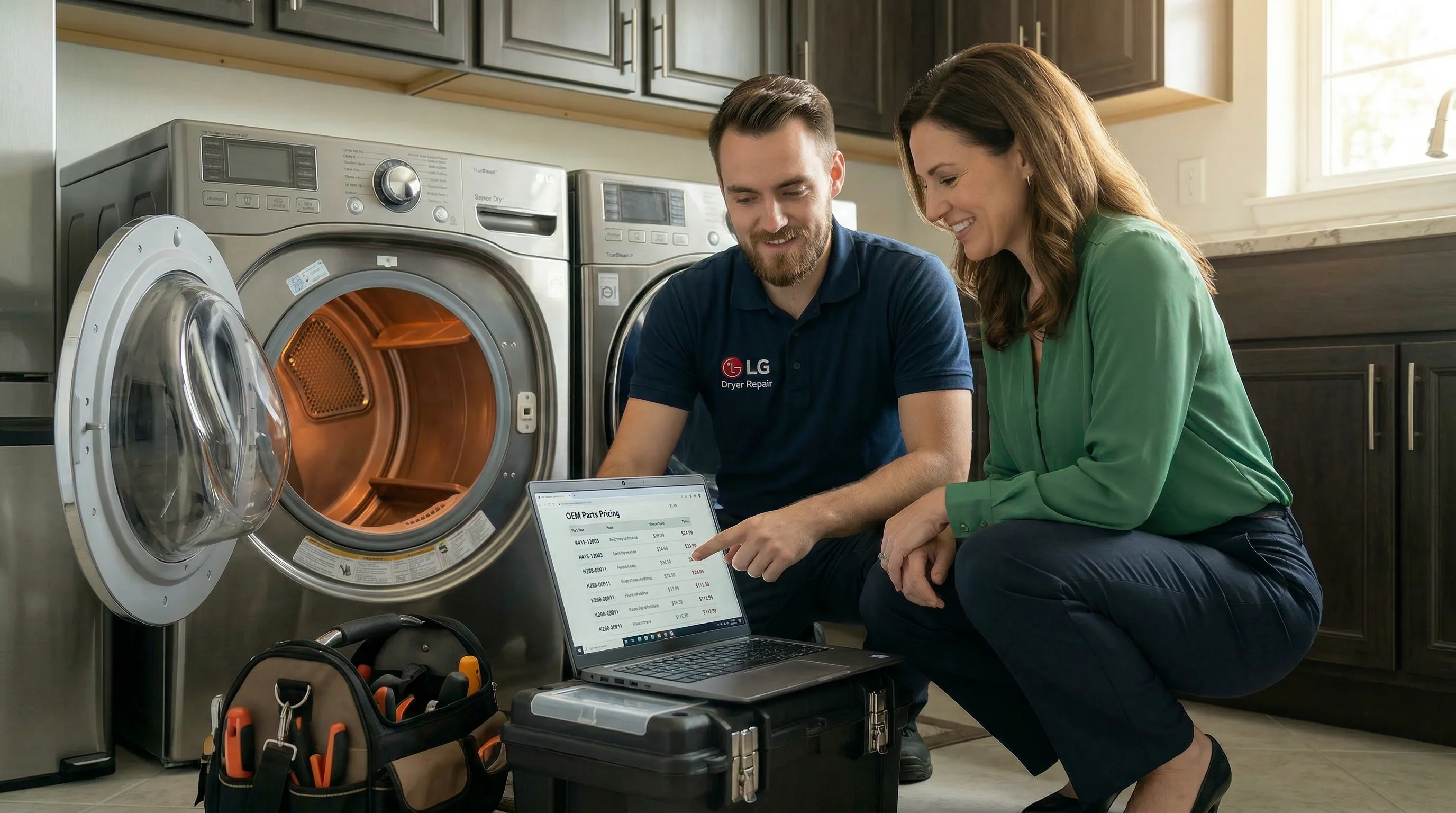
Most dryer vent installs we do in Los Angeles aren't new construction — they're fixing a run someone else did wrong. A 30-foot foil duct snaked through a closet, four 90-degree elbows behind a garage dryer, a brand-new LG throwing d80 on its third load. We install to LG's airflow spec — short rigid metal runs, proper termination — usually same-day, $150–350. Our techs assess the run before we quote. Call (323) 990-7550.
Cost breakdown
What Dryer Vent Installation Actually Costs in LA
Most installs land between $150 and $350, and the number comes down to the run itself. We measure the actual route and quote a fixed price before we touch anything — the $65 assessment is waived when you approve the work.
Short, direct run — low end. A straight shot to an exterior wall right behind the dryer is minimal duct, one cap, about an hour of work. This is where the price starts.
Long run or extra elbows — mid range. Every added foot of metal duct and every 90-degree turn it takes to reach the exterior raises the total. Interior laundry rooms that sit away from an outside wall land here.
Re-route or foil replacement — top end. Moving the exhaust to a different wall, up through a roof, or out of a second-floor or closet laundry is the most involved job. So is tearing out an old foil run and building the whole path fresh in code rigid metal — we're not reusing anything, so it's priced as a full install.
Why Vent Installs Go Wrong in Older LA Homes
In a lot of older LA houses — craftsman bungalows, post-war tract homes — the laundry ended up nowhere near an exterior wall. Whoever set up the dryer ran the duct however it would reach: thirty feet through a wall and across a ceiling, three or four 90-degree elbows stacked behind the machine, a length of accordion foil crushed flat where the dryer got pushed back. Each of those adds back-pressure.
A modern LG measures that restriction and flags it — d80, d90, or d95 — on a dryer that's running perfectly. People assume the new machine is defective. It isn't. The exhaust path is choking it. The fix is giving the air a clean way out, not replacing a dryer that was never broken.
How We Install a Code-Compliant Vent
We build the run in semi-rigid or rigid metal — never thin foil — on the shortest practical path, using gentle sweeps instead of hard elbows wherever the layout allows. Joints get sealed with foil tape, not screws; screws poke into the airflow and snag lint, which starts the next clog. The run ends in a weatherproof cap with a backdraft damper that opens under airflow and closes when the dryer's off, so birds and rodents stay out of the duct.
Before we leave, we run the dryer and read the airflow at the cap. On an LG that means confirming the display is clear of d80/d90/d95 and feeling strong exhaust at the wall. We don't call the job finished until that reads right.
Installation vs. Cleaning — Which Do You Need?
These are two different jobs, and we'll tell you which one you actually need after we see the run. Installation means new duct — a first-time run, a re-route, or pulling out bad foil and replacing it with metal. Cleaning means clearing lint out of a duct that's already built correctly.
If your vent is the original foil maze or it dumps into the attic, cleaning it just resets the clock — you want a proper install. If it's good rigid duct that's simply packed with lint, you want a vent cleaning at $150–200, not a new install. We don't sell you the bigger job when the smaller one fixes it.
Dryer Vent Fire Safety
Clogged and badly built dryer vents cause roughly 2,900 home fires a year in the US, and the worst offender is thin foil duct. It sags, it traps lint at every ridge, and it gives a fire both fuel and a path to spread. That's why we install rigid metal: it holds its shape, sheds lint instead of catching it, and won't feed a flame the way foil does. A clean metal run vented straight outside is the single biggest thing you can do to keep a dryer from turning into a fire risk.
Questions About Dryer Vent Installation Cost
How much does dryer vent installation cost in Los Angeles?
Most installs run $150–350. A short straight run to an exterior wall sits at the low end; a long run, a re-route for a second-floor or closet laundry, or replacing old foil with code-compliant rigid metal pushes toward the top. We quote the exact number on-site after we see the run, and the $65 assessment is waived when you approve the work. We're licensed with the Bureau of Household Goods and Services (#49573).
Why does my new LG dryer throw a d80 or d90 code right after install?
Almost always the vent run, not the dryer. d80/d90/d95 are airflow-restriction warnings — a duct that's too long, has too many 90° elbows, or uses crushed foil makes the dryer read back-pressure and flag it. We install to LG's airflow spec: short rigid runs, gentle bends, a clean termination cap.
Can you install a dryer vent where there isn't one?
Yes. Re-routing to a new exterior wall, through a roof, or for a relocated laundry room is a common call in older LA homes where the laundry sits far from any outside wall. We cut, route, seal, and fit a backdraft-damper cap.
Is foil flex duct safe for an LG dryer?
We replace it on most installs. Thin accordion foil crushes behind the machine, traps lint, and feeds fires — dryer vents cause roughly 2,900 home fires a year. We use semi-rigid or rigid metal to code, which holds airflow and resists kinking.
How long does a dryer vent installation take?
A standard run is 1–2 hours, same-day. A full re-route or a long second-floor run can take 2–4 hours. We confirm the arrival window before we come out.